

“We implement an AI-based ERP system in 90 days”Norbert Gronau in conversation with Sanjay Brahmawar, CEO of QAD | Redzone, at Hannover Messe
18.05.2026 - von ERP Redaktion
Lesedauer: 5 Minuten
|
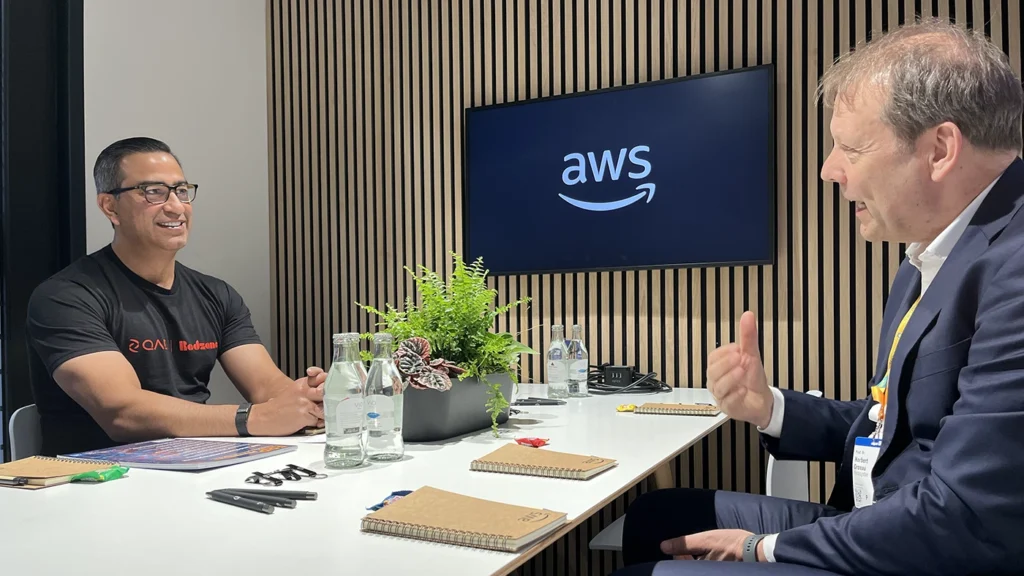
What does it take for a global software company to truly succeed in the German-speaking SME (Mittelstand) market? Sanjay Brahmawar, CEO of QAD | Redzone, brings a unique perspective: he knows Germany from personal experience and sees enormous potential, particularly in the EMEA region. In this interview, he discusses why previous approaches often fell short and what is changing now. At the center of this shift is a manufacturing platform that no longer views ERP solely through a financial lens, but builds it consistently from the production floor up—complemented by agentic AI that supports operational workflows and brings decision-making closer to day-to-day business.
For the media cooperation between QAD and FACTORY INNOVATION, the question arises: How can QAD further expand its presence in the German-speaking region? Internationally, QAD is already a major player, while its visibility in the German market still has room for improvement.
As the CEO of a company who lived in Germany for ten years, I know and understand the local market very well. I see enormous potential, especially in the German Mittelstand, which I value highly and which perfectly matches our ideal customer profile. We want to make our technologies accessible specifically to these medium-sized companies.
Despite our ambitions for Germany, we haven’t always approached the market with the right strategies and solutions in the past. However, we now possess strong capabilities—particularly thanks to AI—that we can deploy very quickly into production. This is exactly what we are achieving through our manufacturing platform, which essentially consists of three parts.
The first component is „Redzone,“ our connected workforce solution. This is about data directly at the workstation, empowering frontline employees with new possibilities. Then there is „Adaptive,“ our ERP system, which I describe as the „intelligent backbone“ because it covers all processes. The third building block is „ChampionAI,“ our agentic AI layer. This is not a generic layer sitting on top, but a deeply integrated level embedded into both the connected workforce and the ERP system.
We provide our customers with agents in three categories, with the first category focusing on all roles within manufacturing. This is where our particular strength lies: we are deeply rooted in production. Our system was designed consistently starting from the Bill of Materials (BOM). Systems developed on this foundation are particularly sophisticated and powerful.
… Unlike generic ERPs, which almost all start from financial transactions and workflows instead of the BOM.
Exactly. We are particularly strongly positioned in our core industries. These primarily include Automotive, Industrial Manufacturing, Food & Beverage, and Life Sciences (MedTech).
We provide agents in three central areas. The first area covers persona-based agents. Typical roles such as plant managers, supervisors, or planners are defined, each performing specific tasks in the system. We have developed agents for these personas that take over many routine tasks. This significantly increases productivity and allows employees to focus on more critical decisions.
The second area concerns processes with a direct impact on a company’s P&L (Profit and Loss statement). A good example is inventory carrying costs, which are among the largest cost factors in many manufacturing plants. Our agents analyze the entire material flow—from goods receipt through production to shipping—and optimize inventory levels. This helps avoid bottlenecks, which are one of the biggest problems in manufacturing. Since humans often act more conservatively here, the agents achieve better results. In practice, we are already seeing inventory reductions of 15 to 25 percent after just a few months, which directly improves margins. Especially in the Mittelstand, where EBITDA margins are often between 8 and 12 percent, even small improvements make a huge difference.
The third area concerns implementation: How can a system be introduced in a medium-sized manufacturing company in as little as 90 days? For this, we use specialized agents that handle tasks such as data migration, data validation, testing, configuration, and the migration of customizations. This is complemented by our „Champion Pace“ methodology, which enables us to realize a full implementation in 90 to 150 days.
Do you already have pilot customers?
Yes, we have already gone live with these customers.
Can you name a few?
Tenneco, a global automotive supplier for seating, is a good example from the automotive industry for whom we implemented an Adaptive ERP.
How do you see your position in the American market?
I am based in Miami—partly because a large portion of our US customers are located in the Midwest and on the East Coast, for instance in regions around Chicago where many automotive companies are based.
To return to your original question about how we intend to grow: we are investing specifically in the EMEA region. To this end, we have hired new leadership, including Sania Khan as General Manager for our ERP business and Ahmad Salama as General Manager for the Redzone division. Under their leadership, we are currently building strong teams—not just for sales and market access, but above all to successfully implement our solutions for customers.
At the same time, we are convinced that we cannot go this path alone. That is why we are establishing a strong partner ecosystem to support us, particularly with on-site implementation and in the respective local languages. Because, especially in the Mittelstand, it is crucial to engage with customers as peers (on eye-level) and in their own language—be it in Germany, France, Italy, Spain, or Portugal.
In ERP projects, the question often arises as to where final decisions are made—for example, centrally in the USA or locally in Europe. My experience with German companies shows that local decision-making paths are often explicitly desired.
We can confirm that. That is why we have intentionally appointed regional managers who have the necessary decision-making authority and know the market intimately. Your point about giving European teams sufficient room to maneuver is very valuable—and that is exactly the direction we are already taking.
Mehr erfahren über
